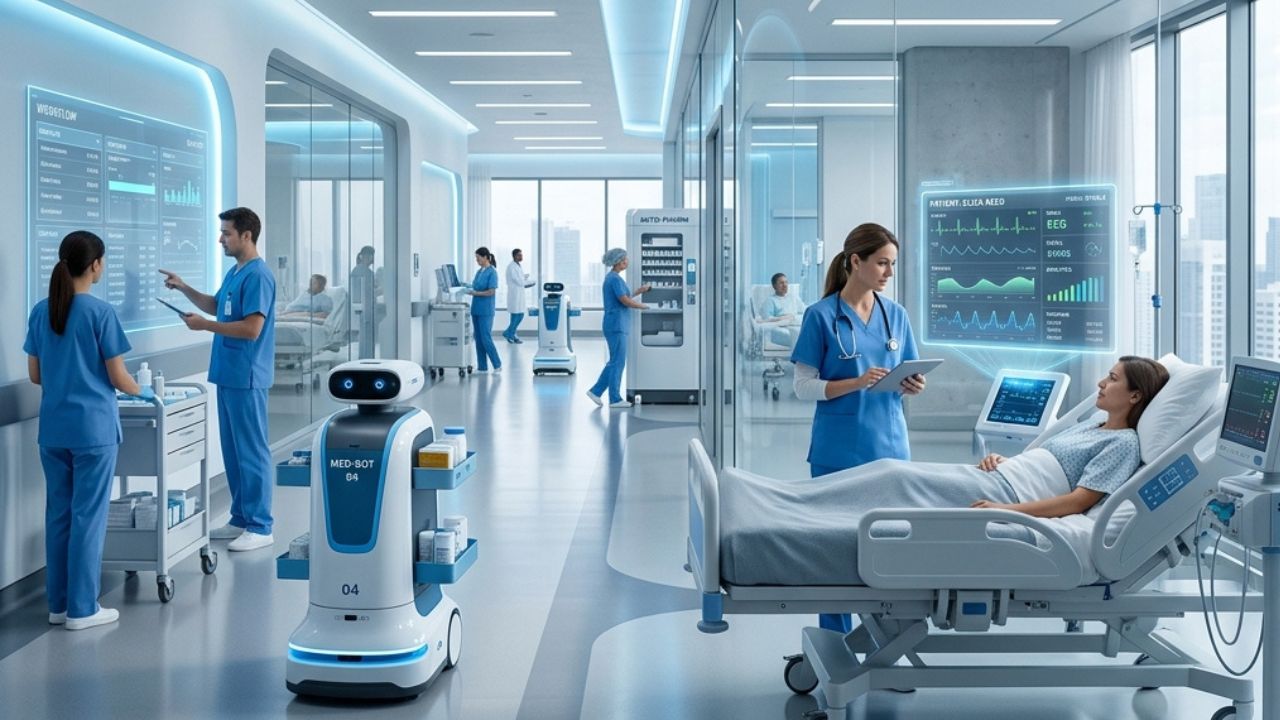
Healthcare automation uses artificial intelligence to streamline hospital operations, lower financial burdens, and enhance patient care. By adopting artificial intelligence for administrative tasks, data management, and predictive analytics, healthcare organizations can significantly reduce overhead costs while freeing up medical professionals to focus on clinical outcomes.
Hospitals currently face a mounting crisis of rising operational costs, severe staff shortages, and increasing patient demands. Medical professionals spend hours every shift dealing with administrative paperwork, scheduling conflicts, and data entry instead of treating patients. This administrative burden drains hospital budgets and accelerates physician burnout.
Artificial intelligence offers a practical solution to these systemic problems. Healthcare automation allows medical facilities to handle repetitive tasks instantly and accurately. By integrating artificial intelligence into daily operations, hospital administrators can optimize resource allocation, reduce costly billing errors, and accelerate diagnostic processes.
The transition toward automated healthcare systems is already underway. Medical networks that fail to adopt artificial intelligence risk falling behind in both financial sustainability and patient care quality. This guide explains how hospital networks can implement healthcare automation to improve efficiency, cut unnecessary expenses, and ultimately deliver better medical outcomes.
What is the current landscape of AI in healthcare?
Artificial intelligence in healthcare encompasses a wide range of technologies designed to mimic human cognitive functions. The current landscape features a rapid adoption of machine learning models, predictive analytics, and natural language processing tools across hospital networks. Administrators use these technologies to analyze massive datasets, from electronic health records to complex medical imaging.
Currently, artificial intelligence primarily operates in the background of medical facilities. Hospitals use automated systems for revenue cycle management, patient scheduling, and initial triage. Rather than replacing doctors, artificial intelligence acts as a digital assistant that processes information faster than humanly possible. This capability is crucial because the volume of medical data doubles every few months. Without automated healthcare systems, medical staff simply cannot review all available patient information before making clinical decisions.
How does artificial intelligence reduce operational costs in hospitals?
The financial burden of running a hospital is staggering, with administrative costs accounting for nearly a quarter of total healthcare spending. Artificial intelligence targets these expenses directly by automating highly manual, error-prone processes. Billing and coding errors cost hospitals billions of dollars annually. Automated medical billing systems use natural language processing to read clinical notes and assign accurate billing codes, drastically reducing claim denials and administrative waste.
Supply chain management is another area where artificial intelligence cuts costs. Hospitals waste significant capital on expired medications and inefficient inventory management. Predictive analytics tools forecast exactly which medications and supplies a hospital will need based on historical admission rates, seasonal illness trends, and demographic data. By optimizing inventory, hospital administrators prevent overstocking and minimize emergency supply orders. Over time, these incremental savings across multiple departments add up to millions of dollars in retained revenue.
How can AI streamline administrative workflows for hospital staff?
Operational efficiency defines the success of a hospital. When workflows stall, patient wait times increase, and care quality drops. Artificial intelligence streamlines workflows by taking over the repetitive tasks that bog down medical staff. For example, patient scheduling systems now use machine learning to predict appointment no-shows. The scheduling software automatically double-books specific time slots or sends targeted reminders to high-risk patients, ensuring doctors’ schedules remain optimized.
During patient visits, artificial intelligence transcription tools listen to doctor-patient conversations and automatically update the electronic health record. This natural language processing technology eliminates the hours physicians typically spend typing up notes at the end of their shifts. Nurses also benefit from automated workflows. Smart ward systems prioritize patient calls based on urgency, directing critical alerts immediately to the appropriate medical professional while routing non-urgent requests to support staff.
What role does AI automation play in enhancing patient care?
While financial and operational benefits are vital, the primary goal of any medical facility is patient health. Healthcare automation enhances patient care by providing medical professionals with actionable, real-time insights. Predictive machine learning models monitor patient vital signs continuously, identifying subtle changes that indicate clinical deterioration hours before a human nurse might notice them. This early warning system allows doctors to intervene proactively, potentially saving lives in intensive care units.
Artificial intelligence also personalizes treatment plans. Machine learning algorithms analyze a patient’s genetic profile, medical history, and lifestyle factors to recommend the most effective therapies. Choose predictive modeling if personalized medicine matters more to your hospital than generic treatment protocols. Furthermore, automated follow-up systems send personalized recovery instructions and check-in surveys to patients after discharge. This continuous engagement reduces readmission rates and ensures patients follow their prescribed recovery regimens at home.
Which key AI technologies are driving transformation in healthcare?
Several distinct branches of artificial intelligence drive the current transformation in healthcare. Understanding these specific technologies helps hospital administrators choose the right tools for their facilities.
First, natural language processing allows computers to understand and interpret human language. Hospitals use natural language processing to extract data from unstructured clinical notes, automatically populate medical databases, and power patient-facing chatbots for triage and scheduling.
Second, computer vision analyzes visual data with incredible accuracy. Radiologists use computer vision algorithms to highlight anomalies in X-rays, MRIs, and CT scans. The artificial intelligence flags potential tumors or fractures, ensuring the human radiologist prioritizes the most urgent cases.
Third, robotic process automation handles the copying, pasting, and moving of data between disparate hospital software systems. Robotic process automation operates exactly like a human data entry clerk, but at lightning speed and without making typographical errors.
What are the main challenges of implementing AI in hospitals?
Despite the clear benefits, implementing artificial intelligence in healthcare involves significant challenges. Data privacy and security represent the largest hurdles. Hospitals must ensure that any artificial intelligence platform complies strictly with health data privacy regulations. Because machine learning models require vast amounts of patient data to function accurately, securing this data against cyberattacks is a top priority for hospital IT departments.
Another major challenge is integration. Many hospitals rely on legacy software systems that do not easily communicate with modern artificial intelligence tools. Upgrading this infrastructure requires substantial upfront capital and technical expertise. Additionally, hospital administrators face cultural resistance from medical staff who may distrust automated recommendations. To overcome this, organizations must invest heavily in staff training and frame artificial intelligence as a supportive tool rather than a replacement for clinical judgment.
What are some real-world examples of AI success in healthcare?
Real-world applications demonstrate the tangible value of healthcare automation. For instance, the Mayo Clinic implemented an artificial intelligence algorithm to screen for asymptomatic left ventricular dysfunction—a silent heart condition. The AI tool analyzed routine EKGs and accurately identified patients at risk, allowing cardiologists to treat the condition before it progressed to heart failure.
Similarly, Mount Sinai Hospital in New York deployed a predictive artificial intelligence system to identify patients at high risk of falling during their hospital stay. By analyzing patient data and medications in real-time, the system alerted nursing staff to monitor specific individuals more closely. This proactive healthcare automation significantly reduced patient falls and the associated liabilities.
In the administrative sector, numerous regional health systems have adopted robotic process automation to handle insurance pre-authorizations. What previously took staff members 15 minutes per patient now takes the software seconds, leading to faster patient admissions and reduced administrative backlog.
How will AI and healthcare professionals work together in the future?
The future of healthcare relies on a synergistic relationship between human professionals and artificial intelligence. Artificial intelligence will not replace doctors; doctors who use artificial intelligence will replace doctors who do not. As algorithms become more sophisticated, they will take over virtually all data processing and administrative coordination within medical facilities.
This shift will allow human medical professionals to focus entirely on the aspects of medicine that require empathy, complex ethical reasoning, and physical dexterity. Surgeons will use augmented reality overlays powered by artificial intelligence to perform highly precise procedures. Primary care physicians will rely on artificial intelligence to monitor their patients’ wearable health devices constantly, shifting the medical paradigm from reactive treatment to proactive prevention.
Taking the Next Steps Toward Healthcare Automation
Healthcare automation is no longer an experimental concept; it is a critical necessity for modern hospitals. As patient populations age and medical demands increase, traditional hospital workflows will simply break down under the pressure. Artificial intelligence provides the scalability and efficiency required to meet these challenges head-on.
Hospital administrators must begin their artificial intelligence journey today by identifying their most resource-intensive bottlenecks. Whether the problem lies in medical billing, patient scheduling, or diagnostic imaging, there is likely an artificial intelligence solution ready to deploy. Start with small, highly targeted robotic process automation projects to build institutional trust, then gradually expand into clinical predictive analytics. By embracing healthcare automation, hospitals can secure their financial futures while delivering the highest possible standard of patient care.
Frequently Asked Questions
What is healthcare automation?
Healthcare automation involves using technology, specifically artificial intelligence and robotic process automation, to perform routine hospital tasks without human intervention. This includes administrative duties like medical billing and scheduling, as well as clinical tasks like analyzing medical imagery and monitoring patient vital signs.
How much does it cost to implement AI in a hospital?
The cost of implementing artificial intelligence in a hospital varies widely based on the system’s complexity. Small administrative robotic process automation tools may cost a few thousand dollars annually, while comprehensive clinical machine learning platforms can require multi-million dollar investments. However, hospitals typically see a return on investment within 12 to 18 months through reduced administrative overhead and fewer denied insurance claims.
Will artificial intelligence replace doctors and nurses?
No, artificial intelligence will not replace doctors and nurses. Artificial intelligence serves as an advanced support tool that processes data and automates repetitive tasks. It frees medical professionals from administrative burdens so they can spend more direct time treating and communicating with patients.
Is patient data safe when hospitals use artificial intelligence?
Patient data remains safe when hospitals use artificial intelligence systems that comply with national health privacy regulations (such as HIPAA in the United States). Reputable healthcare artificial intelligence vendors use advanced encryption and secure cloud environments to protect sensitive medical records from unauthorized access.
How long does it take to train hospital staff on new AI systems?
Training hospital staff on new artificial intelligence systems typically takes between two to six weeks, depending on the software’s complexity. User-friendly administrative tools require minimal training, whereas clinical decision-support systems require comprehensive education to ensure physicians understand how the algorithm formulates its recommendations.