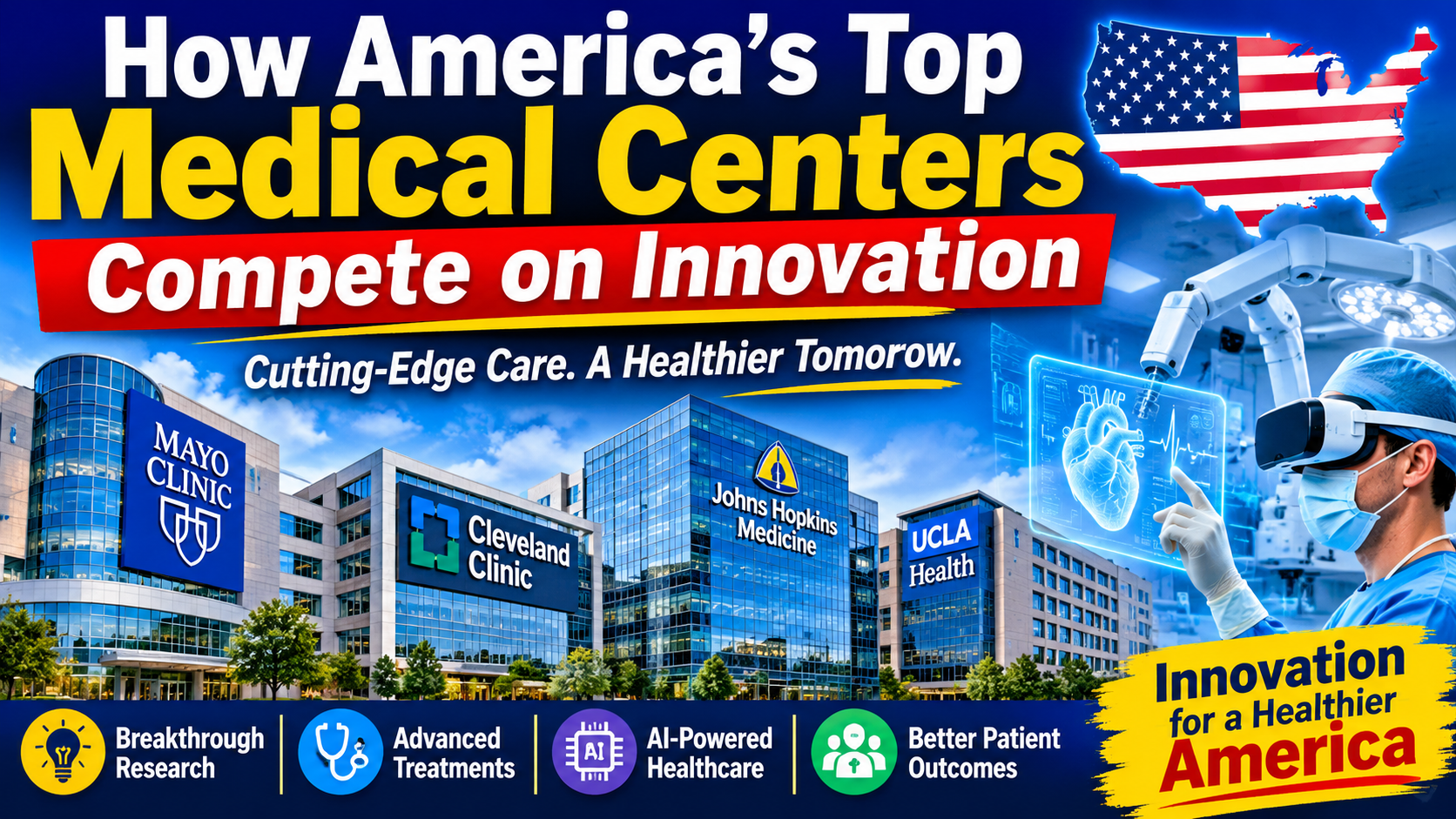
Leading American medical centers compete on innovation through investment in research, advanced technology like AI diagnostics and surgical robotics, digital health platforms, and specialized centers of excellence. Institutions such as Mayo Clinic, Cleveland Clinic, and Johns Hopkins differentiate themselves by combining clinical care with cutting-edge research, academic partnerships, and top-tier talent. This competition ultimately drives better patient outcomes and reshapes the future of healthcare delivery.
Walk into any top-tier hospital today and you’ll notice something beyond white coats and waiting rooms. You’ll find research labs embedded steps away from patient wards, surgical robots guided by AI, and clinicians who split their time between treating patients and publishing breakthrough studies. This is what innovation looks like in modern healthcare, and it’s become the defining battleground for the nation’s most prestigious medical centers.
Innovation in healthcare isn’t limited to flashy new gadgets. It spans everything from genomic medicine and precision diagnostics to digital patient portals and entirely new models of care delivery. For medical centers, how well they innovate directly determines who they can recruit, how patients perceive them, and ultimately, how many lives they can improve or save.
Competition on innovation matters because the stakes are so high. Patients increasingly research their options before choosing where to seek treatment, especially for complex conditions like cancer, heart disease, or rare genetic disorders. Institutions that demonstrate leadership in research and technology attract these patients, along with the funding, talent, and partnerships that sustain long-term growth.
This post breaks down how America’s leading medical centers compete on innovation: the trends shaping the landscape, where the competition is fiercest, what financial forces are at play, and where the industry is heading next.
What Is Driving Innovation Competition in American Healthcare?
Several forces are converging to make innovation a strategic necessity rather than an optional investment for hospitals and health systems.
Precision Medicine, AI Diagnostics, and Minimally Invasive Procedures Are Reshaping Patient Care
Precision medicine tailors treatment to an individual’s genetic makeup, lifestyle, and environment rather than applying a one-size-fits-all protocol. This approach has transformed oncology especially, where genomic testing can identify which therapies are most likely to work for a specific tumor type. Medical centers that offer this level of personalization position themselves as destinations for patients seeking the most effective, least invasive treatment options.
AI-powered diagnostics are following a similar trajectory. Machine learning models can now assist radiologists in detecting abnormalities in imaging scans, flag early signs of disease, and help clinicians make faster, more accurate decisions. Meanwhile, minimally invasive procedures, often enabled by robotic-assisted surgery, reduce recovery times and complication rates, giving hospitals that adopt these tools a clear differentiator in patient outcomes.
R&D Investment Has Become a Competitive Advantage for Top Institutions
Medical centers that commit substantial resources to research and development don’t just advance medicine. They build reputational capital that attracts patients, donors, and top physicians. Hospitals with a strong R&D pipeline can offer patients access to experimental treatments and clinical trials unavailable elsewhere, which becomes a powerful draw for people facing serious or rare conditions.
Why Do Academic Partnerships and Clinical Trials Matter for Innovation Leadership?
Academic medical centers hold a structural advantage in this race. Their affiliations with universities give them access to research funding, graduate talent pipelines, and collaborative opportunities with scientists across disciplines. Clinical trials, in particular, serve as both a research function and a marketing signal: an institution running cutting-edge trials demonstrates it’s shaping the future of medicine, not just following it.
Where Are Medical Centers Competing Most Fiercely on Innovation?
The competition plays out across several distinct but interconnected areas.
Advanced Technology and Equipment
State-of-the-art imaging systems, surgical robots, and diagnostic tools represent some of the most visible investments medical centers make. High-resolution MRI and CT machines, robotic surgical platforms, and AI-assisted diagnostic software all require significant capital, but they also directly improve diagnostic accuracy and surgical precision. Hospitals that fall behind on this technological curve risk losing both patients and physicians who want access to the best available tools.
Research and Development
Breakthrough treatments don’t happen by accident. They result from sustained investment in laboratories, clinical trial infrastructure, and partnerships with pharmaceutical and biotech companies. Medical centers that lead in drug development and novel therapy research often become the first to offer patients access to treatments years before they reach broader availability.
Digital Health Solutions
Telemedicine platforms, electronic health record (EHR) systems, and patient data analytics have moved from convenience features to core infrastructure. Patients now expect virtual visit options, easy access to their health records, and personalized health insights. Behind the scenes, data analytics tools help medical centers identify population health trends, optimize resource allocation, and improve care coordination across departments.
Specialized Centers of Excellence: What Makes Them a Competitive Differentiator?
Many leading medical centers build their reputations around specialized centers of excellence in fields like oncology, cardiology, neurology, and transplant medicine. These centers concentrate expertise, technology, and research efforts into a single focus area, allowing institutions to achieve outcomes that general hospitals often can’t match. A hospital known for cardiovascular innovation, for instance, can attract patients from across the country seeking the most advanced cardiac care available.
Talent Acquisition
None of this innovation is possible without the right people. Leading medical centers compete intensely to recruit top physicians, researchers, and healthcare professionals. The strongest talent gravitates toward institutions offering access to cutting-edge technology, robust research funding, and opportunities for professional advancement, creating a reinforcing cycle where innovation attracts talent, and talent drives further innovation.
How Do Leading Medical Centers Put Innovation Into Practice?
Looking at specific institutions helps illustrate how these competitive strategies play out in practice.
How Does Mayo Clinic Integrate Research Into Patient Care Delivery?
Mayo Clinic has built its reputation on tightly integrating research with clinical practice. Physicians at Mayo Clinic often work alongside researchers, meaning insights from ongoing studies can inform patient treatment decisions more quickly than at institutions where research and clinical care operate separately. This model allows the organization to translate scientific discoveries into real-world patient benefits at a faster pace.
What Is Cleveland Clinic’s Approach to Cardiovascular Innovation?
Cleveland Clinic has long been recognized for its leadership in cardiovascular care, an area where the institution has concentrated significant research and clinical resources. By building deep specialization in heart disease treatment and prevention, Cleveland Clinic has positioned itself as a destination for patients seeking advanced cardiac interventions, reinforcing its identity as a center of excellence in this field.
How Is Johns Hopkins Advancing Cancer Research and Treatment?
Johns Hopkins has established itself as a leader in cancer research, leveraging its academic affiliations and research infrastructure to pursue cutting-edge treatment approaches. The institution’s commitment to cancer research reflects a broader strategy among academic medical centers: using deep research capability as a foundation for clinical leadership in complex disease areas.
What Is the Financial Reality Behind Healthcare Innovation?
Innovation doesn’t come cheap, and understanding the financial dimension is essential to understanding why some institutions pull ahead while others struggle to keep pace.
How Do Innovation Investments Affect Hospital Operating Costs?
Investing in new technology, research infrastructure, and specialized programs increases operational costs significantly. Advanced imaging equipment, surgical robots, and digital health platforms all require substantial upfront capital and ongoing maintenance. For many institutions, these costs must be weighed carefully against other operational priorities, making strategic prioritization essential.
Where Does Funding for Medical Innovation Come From?
Medical centers typically draw on a mix of funding sources to support innovation, including government research grants, private philanthropic donations, and revenue generated from specialized clinical services. Institutions with strong reputations and track records of success often find it easier to attract both grant funding and donor support, creating a cycle where established innovation leaders have greater access to the resources needed to maintain their edge.
What Is the Return on Investment for Healthcare Innovation?
Choose innovation investment if long-term reputation and patient outcomes matter more than short-term cost containment. The return on these investments often shows up in patient satisfaction scores, institutional reputation, and market share growth rather than immediate revenue. Hospitals that successfully innovate tend to see increased patient volume, improved clinical outcomes, and stronger ability to recruit top talent, benefits that compound over time even if the initial investment doesn’t pay off immediately.
What Challenges Do Medical Centers Face in the Innovation Race?
Despite the clear benefits, pursuing innovation leadership comes with real obstacles.
The High Cost of Research and Technology Implementation
Not every medical center has the financial resources to compete at the highest level of technological investment. The cost of acquiring advanced equipment, building research infrastructure, and maintaining specialized programs can be prohibitive, particularly for smaller or regional hospitals without access to major philanthropic or academic funding sources.
How Do Regulatory Approval Timelines Affect Innovation Speed?
New treatments and medical technologies must pass through rigorous regulatory approval processes before they can be widely adopted. While these processes exist to protect patient safety, they can also slow the pace at which innovations reach patients, creating a gap between what’s scientifically possible and what’s clinically available.
Talent Competition Among Institutions
As mentioned earlier, the best physicians and researchers have their pick of where to work. This creates intense competition among leading medical centers, often driving up compensation costs and making retention a constant strategic priority.
Can Medical Centers Balance Innovation With Accessibility and Affordability?
One of the most pressing tensions in healthcare innovation is ensuring that breakthrough treatments and technologies remain accessible to patients regardless of income level. Advanced therapies developed at leading research institutions can carry significant costs, raising questions about equitable access. Medical centers pursuing innovation leadership must grapple with how to balance cutting-edge care with affordability for the broader patient population.
What Does the Future Hold for Medical Center Innovation?
Looking ahead, several trends are poised to reshape how medical centers compete.
Personalized and Genomic Medicine Will Continue to Expand
As genomic sequencing becomes more affordable and widely available, personalized medicine will likely move from a specialized offering to a standard component of care across many medical specialties, not just oncology.
Artificial Intelligence Will Play a Growing Role in Diagnostics and Treatment Planning
AI’s role in healthcare is still in its early stages. Future applications will likely extend beyond diagnostic assistance into treatment planning, predictive analytics for patient outcomes, and administrative efficiency, giving early adopters a lasting competitive advantage.
Virtual and Hybrid Care Models Will Become More Sophisticated
Telemedicine proved its value out of necessity, but the future points toward more sophisticated hybrid care models that blend in-person and virtual visits based on what best serves each patient’s specific needs.
Sustainability Will Become a Factor in Healthcare Competition
Green healthcare practices, from energy-efficient facilities to reduced medical waste, are increasingly becoming part of how institutions define themselves as forward-thinking and responsible, adding a new dimension to how medical centers differentiate themselves.
Why Innovation Competition Ultimately Benefits Patients
Innovation isn’t just a strategic buzzword for hospital executives. It’s the mechanism through which American healthcare continues to improve, one breakthrough treatment and technological advance at a time. The medical centers willing to invest strategically in research, technology, and talent today are the ones that will define what quality care looks like tomorrow.
For patients, this competition translates directly into better outcomes: more precise diagnoses, less invasive treatments, and access to therapies that didn’t exist a decade ago. As institutions like Mayo Clinic, Cleveland Clinic, and Johns Hopkins continue pushing the boundaries of what’s clinically possible, the broader healthcare system benefits from the higher standards they set.
The institutions that will lead American healthcare in the coming decades won’t necessarily be the largest or the oldest. They’ll be the ones that most effectively combine research ambition, technological investment, and talent development into a coherent strategy for improving patient care.
Frequently Asked Questions
What does “innovation” mean in the context of a medical center?
Innovation in healthcare refers to the development and adoption of new treatments, technologies, and care delivery models that improve patient outcomes. This includes advances like precision medicine, AI-assisted diagnostics, minimally invasive surgical techniques, and digital health platforms.
Why do medical centers compete on innovation rather than just cost or convenience?
Patients, particularly those with complex or serious conditions, often prioritize access to the most advanced treatment options over cost or convenience. Medical centers that lead in innovation attract these patients, along with the research funding, philanthropic support, and top talent needed to sustain long-term growth.
How much does it cost a hospital to invest in innovation?
Costs vary widely depending on the scope of investment, ranging from individual pieces of diagnostic equipment to entire research infrastructure and specialized clinical programs. Funding typically comes from a combination of government grants, private donations, and revenue from specialized services.
Are smaller hospitals able to compete with major academic medical centers on innovation?
Smaller hospitals often face resource constraints that make it difficult to match the research infrastructure of major academic medical centers. However, many pursue innovation strategically by partnering with larger institutions, focusing on specific specialties, or adopting proven technologies rather than developing them independently.
Does healthcare innovation make treatment more expensive for patients?
Advanced treatments and technologies can carry higher costs, which raises valid concerns about accessibility. Leading medical centers must balance their innovation investments with efforts to ensure that breakthrough therapies remain accessible to a broad range of patients, not just those with significant financial resources.